

Ideas Test: From public realm commission to civic activation
Ideas Test: From public realm commission to civic activation
By
Wayne Parsons
Throughout 2024-2025, community-first innovators Ideas Test were commissioned as one of seven delivery partners to lay the foundations for creative health to become a permanent, sustainable part of how Medway Unitary Authority supports its communities. They developed HEARD, a project rooted in listening and making change together. Senior Producer Wayne Parsons walks us through the challenges and the successes.
HEARD: A creative health project in Luton, Chatham. Delivered by Ideas Test in partnership with Medway Council.
Who are Ideas Test?
Ideas Test projects bring people together through the power of sharing and collaboration. Our core mission is to make creativity an accessible, integral part of everyday life for everyone - with a specific focus on under-represented communities across Medway and Swale.
We operate differently from traditional arts organisations; we are not a gallery or a theatre, and we do not maintain a central building for the public to visit. Instead, we meet people where they already are: in community spaces, on high streets, in schools, and in local parks. Our job is to identify the creative potential that already exists within people and places and help it come alive. By partnering with artists, local authorities, businesses, and residents, we create projects that matter to the people who take part. HEARD stands as an example of this community-first practice in action.
So what's creative health?
Creative health is the evidence-based principle that creative engagement leads to tangible improvements in health and well-being. It's a broad field encompassing art-making, gardening, dance, singing, and community building - any creative activity that enhances physical or mental health. These activities can occur anywhere - in living rooms, community hubs, GP surgeries and public high streets. Crucially, creative health functions alongside conventional healthcare rather than as a replacement for it.
The evidence for this approach is robust. Regular engagement in creative activities is linked to better mental health, stronger social connections, and lower rates of specific long-term conditions. It supports recovery, reduces social isolation, aids in pain and anxiety management, and restores a sense of agency.
The Creative Health Medway Place Partnership Programme
In 2024, Medway Council received investment from Arts Council England to launch the Medway Creative Health Place Partnership Programme. Spanning 18 months, the programme was designed to:
- Build the skills and confidence of artists and arts organisations to deliver high-quality creative health work.
- Test new approaches and forge new partnerships across health, community, and creative sectors.
- Lay the foundations for creative health to become a permanent, sustainable part of how Medway supports its communities.
Ideas Test was commissioned as one of seven delivery partners to bring this vision to life.
What was HEARD?
Listening as a Radical Act
HEARD was a project rooted in listening to the community it was serving. We set out to listen and act together.
We avoided "delivering a programme at" people; instead, we listened first and acted second. While we began with the idea that the outcome would be a public realm commission, no one knew what that would be at the start.
Phase One: Inspiration and Imagination
Ideas Test brought together 34 local residents for a series of meetings at a local social club. These weren't dry consultations; we provided live music and food from a local restaurant, creating a sense of occasion - a free night out that doubled as a civic conversation.
We asked: “If you had a public realm commission for your area, what would it be?” and “What change do you want to see?”
To expand the horizon of what was possible, we invited seven artists to share work spanning murals, gardens, sound installations, and dance. This phase didn't produce a technical brief; it produced a room of inspired people who had seen what was possible and were ready to talk about their own place with passion.
What the community prioritised
Three themes emerged:
- The litter problem: It was described as demoralising and widespread
- Youth provision: A need for a proper youth centre and skills classes
- A multicultural event: Something to celebrate the richness of Luton's diverse food, music, and dance
Ideas Test focused on the litter problem, tackling it creatively to address the deeper sense that the area wasn't being looked after.
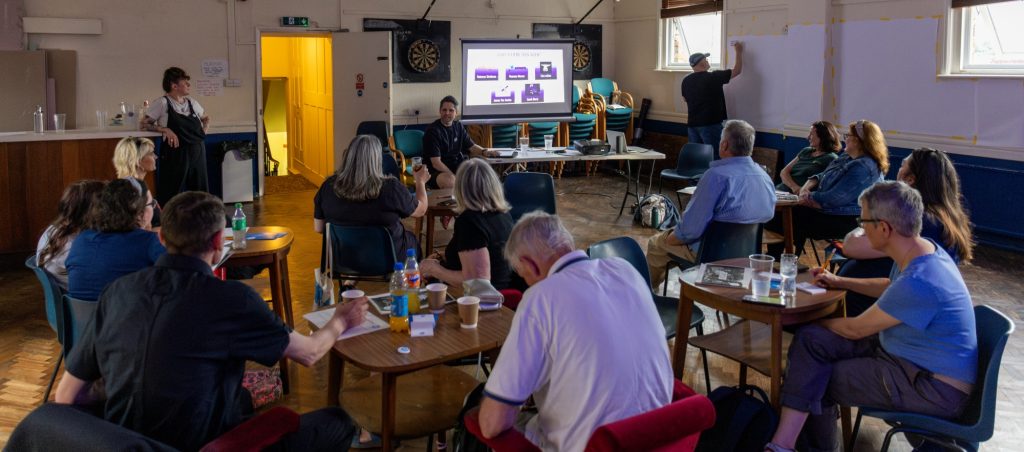
Photo: Tyler Austin
Phase two: The community in action
We developed three creative interventions directly from the community's feedback.
Litter Picks with a Twist
These were not average litter picks. Accompanied by world-champion beatboxer Rupert Oldridge, the sessions became social events. Beyond the physical exercise, these picks acted as a catalyst for conversation; when you are visible and purposeful on the street, people stop to talk.
Creative Workshops in Schools
Ideas Test and Rupert visited schools to capture children’s hopes for Luton Road. Together, we delivered eight workshops. Four where the young people learnt how to beatbox and four where we captured messages about littering and the environment. These sounds and beatboxing rhythms feature in interactive bins installed just outside their school. This ensured that when kids used the bins, they heard their own voices, reinforcing their sense of belonging.
The Talking Bins
We transformed seven bins on Luton Road into interactive sculptures designed by artist Thor McIntyre-Burnie from Aswarm. Thor was actually one of the artists who presented at the initial meetings with the community. These were installed with help from Norse and Medway Council, and the bins responded to use by playing recordings of beatbox-based messages recorded in our workshops in the schools led by Rupert. They turned a mundane act into a moment of joy.
The bins also featured a QR code that, when scanned, directed you toward a full playlist of all 40+ tracks recorded by primary school children from Luton and Phoenix Primary schools during the workshops.
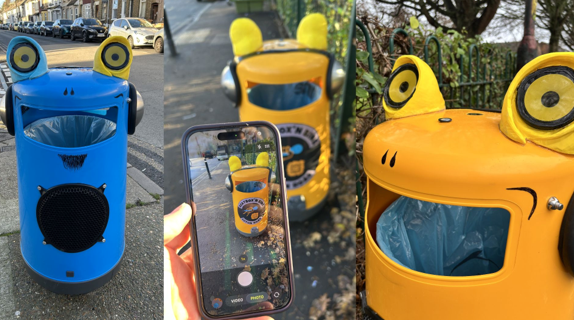
Photo: Wayne Parsons
Why does it matter?
Luton sits among the most deprived areas in Medway, with higher-than-average rates of long-term ill health, unemployment, and housing stress. Luton Road is a busy residential artery with a richly diverse, often transient community where over 40 languages are spoken in the local school. The challenge was reaching a fragmented population; the answer was visibility and consistency: showing up every fortnight to do something positive.
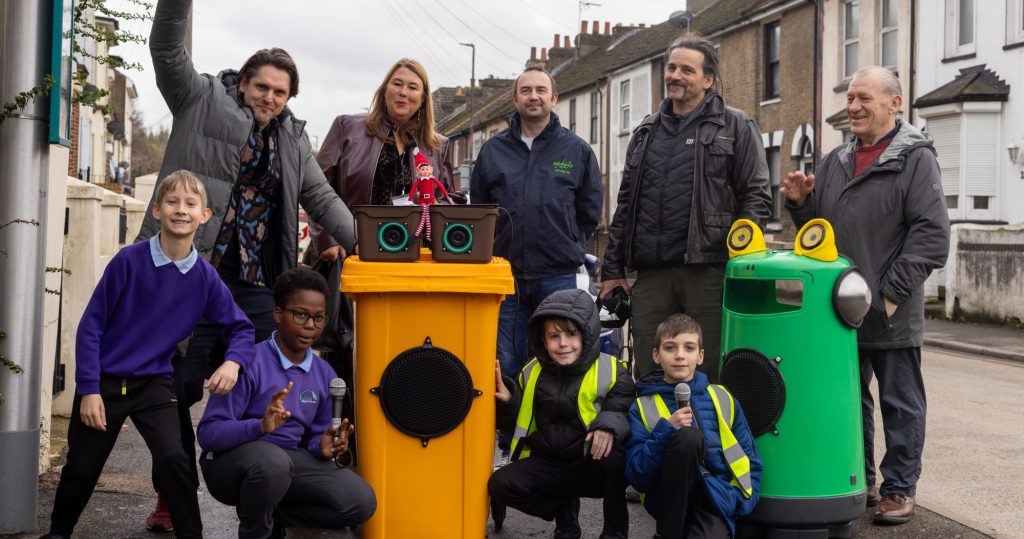
Photo: Tyler Austin
Impact on health: The data behind the joy
HEARD was not just about litter; it was about people. Ideas Test tracked the impact on every participant and passer-by.
Getting People Moving in
- Distance - Across nine sessions, participants walked a combined 27.13 km - the distance from Chatham to Maidstone and back.
- Steps - They took nearly 30,000 steps in total.
- Energy - The average calories burned per session was around 428 - the equivalent of a moderate spin class.
The key was that no one was thinking about exercise. Physical activity was a by-product of doing something that felt worthwhile - improving the street and chatting with neighbours.
Building Real Community
- Conversations - Over nine sessions, we had 390 conversations with residents and shop owners.
- Impromptu beatboxing on the street - We took a bin designed with a speaker onto the street for impromptu beatboxing trials led by Rupert Oldridge. Like a "Pied Piper," Rupert drew people out of their houses; groups of children followed him down the street, and participants ranged from young primary students to a gentleman in his 80s.
- Connection - By the end, shop owners were handing out bottles of water, cans of soft drinks, offering free pizza. Motorists were honking in support.
- Something shifting on the street - The road itself changed. Stretches that were consistently littered in September were noticeably cleaner by December. People who came once came back; we built a regular team of five dedicated residents. This is sustainable activity: a small, steady presence that people choose to be part of.
Civic interventions and learning
HEARD liaised with statutory services, working with Medway Council and Norse to coordinate bin installations. We organised a feedback session where residents sat down with the Council's waste team to discuss long-term changes.
Media and Recognition
The "Talking Bins" became a regional story, featuring in three BBC Radio Kent interviews and on the BBC News website. This coverage validated the community’s efforts and amplified the project’s message.
What We Learned
- Listening - Genuine ownership came from residents choosing the direction of the project.
- Joy - Using fun, like beatboxing, is a powerful tool for community work.
- Consistency - Fortnightly presence builds trust in a way one-off events cannot.
- Challenges - Reaching transient communities and sustaining momentum between sessions remains a long-term hurdle.
The future of creative health in Medway
HEARD proves that creative health doesn't need a clinic; it can happen on a road with bins and a beatboxer. It works because of the approach: listening, creative design, and an honest commitment to what the community actually wants.
The numbers at a glance
- Rubbish removed: 219.53 kg
- Distance walked: 27.13 km
- Resident conversations: 390
Legacy: A neighbourhood transformed
The true measure of a community project is what remains once the formal funding ends. For HEARD, the legacy is both physical and social:
- Community-led action - The resident group has officially committed to continuing the litter picks independently. Following their successful dialogue with Medway Council, the group arranged for professional litter-picking kits to be delivered directly to them, allowing them to manage their own regular meet-ups and maintenance schedules.
- Permanent Infrastructure - The "Talking Bins" will remain in place as a permanent feature of Luton’s landscape. These visually striking, animated installations serve as a playful "nudge" to encourage waste disposal while acting as a lasting monument to the community’s collective achievement.
- Empowered Voices - For the adult community, the bins are a reminder of their civic power and successful advocacy. For the younger residents, the project leaves behind a sense of neighbourhood ownership and the creative confidence gained through beatboxing and recording workshops.
HEARD proved that when the conditions are right, built on trust, joy, and consistent presence, people don't just participate; they step up to lead.
Challenges & learning
While the HEARD project achieved significant impact, navigating a truly co-created process in a public space presented several distinct hurdles.
- Seasonal barriers - Launching outdoor community activities during the coldest, darkest months of the year created an immediate "uphill battle" for recruitment. While we maintained a dedicated core team of six committed residents, converting initial interest into active participation proved difficult; many locals provided contact details during our walks but did not ultimately attend the scheduled picks.
- Defining the "ask" in co-creation - We grappled with how to frame our initial consultations. The challenge lay in asking the community what they wanted without knowing the project's final destination. We had to balance an open-ended dialogue with the reality of our parameters as an arts organisation. Finding the "sweet spot" - where we could address local concerns while keeping the focus on the role of arts and culture required constant internal negotiation.
- Navigating "unknown" - Legacies In public realm commissions, legacy planning usually happens at the start. However, our commitment to a co-created approach meant the project’s "end state" remained fluid. We faced a two-fold challenge regarding the future of both the community groups and the physical installations. While the outcome was a success with the council and residents opting to keep the talking bins in situ and form an independent litter picking group, managing the uncertainty of these assets from the outset was a complex balancing act.
Wayne Parsons, Senior Producer, Ideas Test


